Will some Florida cities challenge Uthmeier and kill their immigration enforcement agreements?
Florida Phoenix
Mitch Perry ·
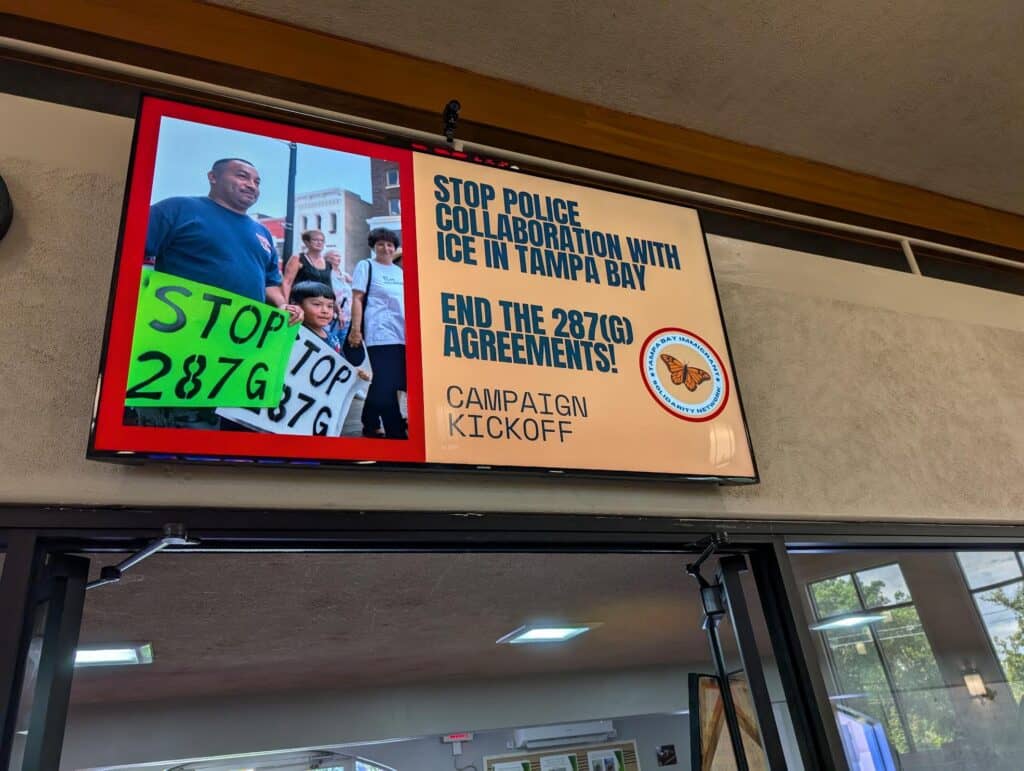
Following midterm elections in which some South Florida Republicans blamed immigration enforcement for surprisingly tight results, city officials in Doral and Tallahassee have expressed interest in repealing cooperation agreements their law enforcement agencies signed with ICE last year. A 2025 Florida law requires counties to sign partnerships with ICE known as 287(g) agreements for their
Following midterm elections in which some South Florida Republicans blamed immigration enforcement for surprisingly tight results, city officials in Doral and Tallahassee have expressed interest in repealing cooperation agreements their law enforcement agencies signed with ICE last year.
A 2025 Florida law requires counties to sign partnerships with ICE known as 287(g) agreements for their jails. If commissioners don’t comply, the governor can temporarily remove them from office and sue to force compliance. All 67 counties have had such agreements in place since April 2025.
That same state law does not require cities to sign such agreements for their police departments and more than 30 cities have never done so . Florida Attorney General James Uthmeier subsequently has threatened elected officials of several Florida cities with removal from office simply for discussing ending their agreements over the past two years, stifling any such attempts.
Now in Tallahassee, at least, newly elected Mayor Jeremy Matlow appears ready to defy those threats.
“My view is, when you look at the state law, it’s pretty clear we didn’t have a mandate [to sign it],” Matlow said Wednesday during a City Commission meeting. “The state admitted that in court that they didn’t have a mandate.”
Speaking in Orlando Thursday, Uthmeier said he had heard “rumblings” about some cities contemplating ending those ICE agreements.
“Here in Florida, I don’t write the law, I enforce it,” he said. “We are always going to be a rule-of-law state. We’ll always enforce the law. Local governments around the state do have Florida law statutory obligations to engage in best efforts to support the federal government in its mission. And there are penalties where they choose to do so without justification.”
Florida Gov-elect Byron Donalds weighed in.
“Florida is not a sanctuary state, and as governor, I will never let it become one,” he wrote on X in response to the Tallahassee’s City Commission’s unanimous vote to reconsider its 287(g) agreement. A final vote has not been scheduled yet.
“Florida cities must comply with federal and state laws — full stop,” Donalds added.
The Phoenix reached out to the governor-elect’s press team to ask if he would push the Legislature to require cities to sign 287(g) agreements once he enters office in January. They did not immediately respond.
In Doral in Miami-Dade County, the city council delayed a discussion about its participation in its 287(g) program Wednesday pending an opinion from Uthmeier’s office. City Councilwoman Maureen Porras has been attempting to introduce an agenda item to reconsider the city’s cooperation with ICE.
The legal opinion that Doral Mayor Christi Fraga asked the attorney general’s office to weigh in on was split into two specific questions: Whether a city in Florida is legally required to enter into a 287 (g) agreement, and whether a city is banned from rescinding or terminating an existing 287 (g) agreement.
That response came back on Thursday from the AG’s office.
Greg Slemp, general counsel in the Attorney General’s Office, wrote in a memo that “consistent with the State’s position in City of South Miami v. DeSantis, a municipality’s failure to execute a 287(g) agreement does not by itself violate Florida law but may provide evidence of an unlawful sanctuary policy.“
“As for the second question, choosing to rescind or terminate an executed 287(g) agreement, without sufficient justification, likely demonstrates a sanctuary policy and lack of ‘best efforts’ by a municipality, which would violate Florida Statutes,” Slemp wrote.
The city of South Miami filed a lawsuit against DeSantis last year to determine whether municipalities must enter into 287(g) agreements. A Leon County circuit judge dismissed the lawsuit without ruling directly on the question posed. He determined the legal claim was “premature” because the city faced no direct state threats or penalties.
South Miami Mayor Javier Fernández said the ruling gave the city “the clarity we need,” and officials there have never signed a 287(g) agreement.
Enforcement delegation
First established in 1996, the 287(g) program authorizes the federal government to delegate certain law enforcement duties concerning immigration to local and state law enforcement agencies.
There are three such models: the Warrant Service program, the Jail Enforcement Model, and the Task Force Model, which deputizes local officers to conduct civil immigration enforcement during the course of their routine work. The Task Force Model is being used in Florida and around the country since Donald Trump returned to the White House for his second term in January 2025.
Florida has 279 agencies using the Task Force Model, according to FWD.US . That’s the second most in the country, trailing only Texas.
‘Hurt us with Hispanics’
While no incumbent Republicans in Congress lost their bids for reelection, two of them in South Florida — Maria Salazar in Congressional District 27 and Mario Díaz-Balart in Congressional District 26 — came close. Those were in districts that two years ago Salazar won by 20 points and Díaz-Balart by 42 points.
South Florida Republican U.S. Rep. Carlos Giménez, told Fox News last week that the intense immigration enforcement policies under President Trump may have hurt the GOP at the ballot box. It wasn’t a fresh comment. Giménez told C-SPAN’s “Ceasefire ” program in March that ICE’s actions had contributed to Florida Republicans losing two special legislative elections held earlier that month.
“I’m telling you that what happened with ICE during the last year hurt the Republicans, all right? Hurt us with Hispanics,” Giménez said. “We made great gains with Hispanics, and then we, because of the way that ICE was enforcing immigration, a lot of Hispanics say, ‘Wait, wait, that’s not what I voted for, all right?’ And so I think that that’s a reflection right there.”
Source
Florida Phoenix